

一. Structural Safety: Build a Solid Stability Foundation for Vertical Equipment
The center of gravity of vertical liquid storage tanks is concentrated in the vertical direction and is often secured by legs/bases. Structural stability directly determines safety, so the following aspects should be considered:
1.Installation Foundation and Fixing:
Foundation Requirements: The mounting surface must be level (error ≤ 0.1%) and meet load-bearing standards (calculated based on the full weight of the liquid storage tank, with a concrete foundation strength of at least C30). Avoid tilting the equipment due to ground subsidence (the tilt angle must not exceed 1°, otherwise it may cause misjudgment of the liquid level sensor or seal failure).
2.Securing Method:
If the liquid storage tank volume is greater than 500L or the medium density is greater than 1.2g/cm³ (such as concentrated sulfuric acid or ethylene glycol), dual fixing with "legs + anchor bolts" is required. The anchor bolts must be embedded in the concrete foundation at least 30cm and tightened according to the equipment manual to prevent loosening. Outdoor installations also require the installation of windbreak cables (for coastal and windy areas, the wind resistance rating must match the local maximum wind speed).
二. Media Compatibility: Precise Matching to Avoid Adverse "Material-Media" Reaction.
The material of the vertical liquid storage device must be fully compatible with the chemical properties (corrosiveness, solubility) and physical conditions (temperature, viscosity) of the media. Improper matching can directly lead to equipment corrosion, media contamination, or safety accidents. Specific requirements are as follows:

In addition, attention should be paid to temperature adaptation: for example, the upper temperature resistance limit of PP material liquid storage container is ≤80℃. If high temperature medium (such as hot water above 80℃) is stored, FRP or stainless steel should be used; low temperature medium (such as ethylene glycol solution at -20℃) should be used. Low temperature steel (such as Q345D) should be used to avoid low temperature brittle cracking of ordinary carbon steel.
三. Operating Specifications: Focusing on the Special Operating Requirements of "Vertical Structures"
The liquid inlet and outlet, level control, and pressure balance of vertical liquid storage tanks differ significantly from those of horizontal ones. Improper operation can easily lead to problems such as "dry run deflation," "overflow from a full tank," and "bottom sediment blockage." The following procedures must be strictly followed:
1. Pre-commissioning Preparation (Critical Steps Not Skipped)
Cleaning and Passivation:
New equipment: First, flush the interior with high-pressure water (pressure ≥ 0.8 MPa) to remove welding slag and oil stains. For stainless steel equipment, passivate with a 5%-10% nitric acid solution (immersion for 2-4 hours), then rinse with deionized water to a neutral pH of 6-8 to prevent rust.
Reused equipment: Select a cleaning agent based on residual media (e.g., citric acid solution for food-grade equipment, ethanol or dilute alkali for chemical equipment). Dry the equipment after cleaning (using compressed air to prevent moisture from reacting with the media). Leakage Test:
Pressure Reservoir: Close all valves and introduce nitrogen (at 0.8 times the design pressure). Maintain pressure for 30 minutes. A pressure drop of ≤0.02 MPa is considered acceptable.
Atmospheric Reservoir: Fill the tank with water to 80% of its capacity and allow it to stand for 24 hours. Observe the tank walls and joints for leaks and a significant drop in the liquid level (excluding evaporation). This is considered acceptable.
Accessory Inspection: Verify that the safety valve, breathing valve, level gauge, and emergency shutoff valve are in "normal standby" mode-for example, the flame arrester core of the breathing valve is not blocked, the level gauge valve is fully open, and the emergency shutoff valve can be opened and closed normally during manual or pneumatic testing.
2. Core Controls During Operation (Avoiding Vertical Structure Risks)
Liquid Level Control: "Full" or "Empty" Tanks are Strictly Prohibited:
During Liquid Intake: Monitor the liquid level in real time using a level gauge. The inflow rate must be ≤ 1/3 of the tank capacity per hour (to prevent liquid from impacting the tank roof and causing a sudden pressure increase). Stop inflow immediately when the high-level alarm is reached (a full tank can easily overflow from the breather valve, causing fire or corrosion).
During Liquid Discharge: Completely draining the liquid is strictly prohibited (especially for media containing particles or high viscosity. Draining the liquid will cause the pump to run dry, and residual particles at the bottom of the tank can easily clog the pipes). Maintain a low liquid level (≥10% of the tank capacity) and a discharge rate ≤ 2/3 of the inflow rate (to prevent negative pressure within the tank, which could block the breather valve and cause the tank to collapse). Pressure and Temperature Monitoring:
Pressure-bearing applications: Record pressure every hour (for example, in a refrigeration system's liquid reservoir, a pressure fluctuation of ≤0.1 MPa is normal). If pressure suddenly rises, check the safety valve for blockage and manually relieve pressure if necessary.
Heating/Tracing Applications: If the medium requires heating (e.g., viscous resin), use jacket heating or a heat tracing pipe (direct open flame heating is strictly prohibited). The heating rate should be ≤5°C/hour, and the temperature should be ≤80% of the material's upper temperature resistance (to prevent localized overheating).
Anti-Static and Leak Prevention:
For flammable and explosive media: The inlet pipe must be inserted below the liquid surface ("submerged feeding" to avoid static electricity generated by liquid splashing). Before each batch, check the static grounding (ground resistance ≤10Ω).
For corrosive media: Inspect the tank wall and joints (e.g., flanges and valves) every two hours to observe for signs of leakage (e.g., alkaline leaks will produce white crystals, acid leaks will produce corrosion). If leaks are detected, immediately stop feeding, drain the tank, and conduct repairs.
3. Post-Service Treatment (Avoiding Residual Hazards)
Media Drainage and Cleaning:
Corrosive/Toxic Media: Use an inert gas (such as nitrogen) to purge any residual material from the tank (purge time ≥ 30 minutes), then rinse with clean water. Finally, soak in a neutralizing solution (e.g., baking soda solution for acid tanks, boric acid solution for alkali tanks) for 1 hour to ensure no residual material remains.
High-Viscosity Media: Rinse the tank walls with a solvent (e.g., acetone for resins) and then clean with high-pressure water to prevent residual material from solidifying and affecting subsequent use.
Equipment Protection:
Short-Term Outages (<1 month): Fill the tank with nitrogen (pressure 0.02-0.05 MPa, "nitrogen seal") to prevent air ingress and corrosion.
Long-Term Outages (>3 months): Clean and dry the tank, close all valves, wrap plastic wrap around the joints to prevent dust ingress, and regularly (monthly) check the tank pressure to ensure the nitrogen seal pressure is normal
四. Maintenance and Inspection: Extending Service Life and Preventing Sudden Failures
Vertical liquid storage tank maintenance should focus on "weak points" in the vertical structure (such as the tank bottom, legs, and overhead accessories). Regular inspections can prevent "minor hazards" from escalating into "major incidents." Specific requirements are as follows:
1. Daily Maintenance (Daily/Weekly)
Daily: Inspect the level gauge (for clarity and no blockage), pressure (for normal operation), and connections (for leaks). Record operating data (pressure, temperature, and liquid level).
Weekly: Clean the breather valve dust cover and flame arrester (using compressed air for purging). Check the static grounding (for loose grounding clamps). Perform manual open/close tests on valves (such as emergency shutoff valves) to ensure they operate freely.
2. Regular maintenance (monthly/quarterly/annually)
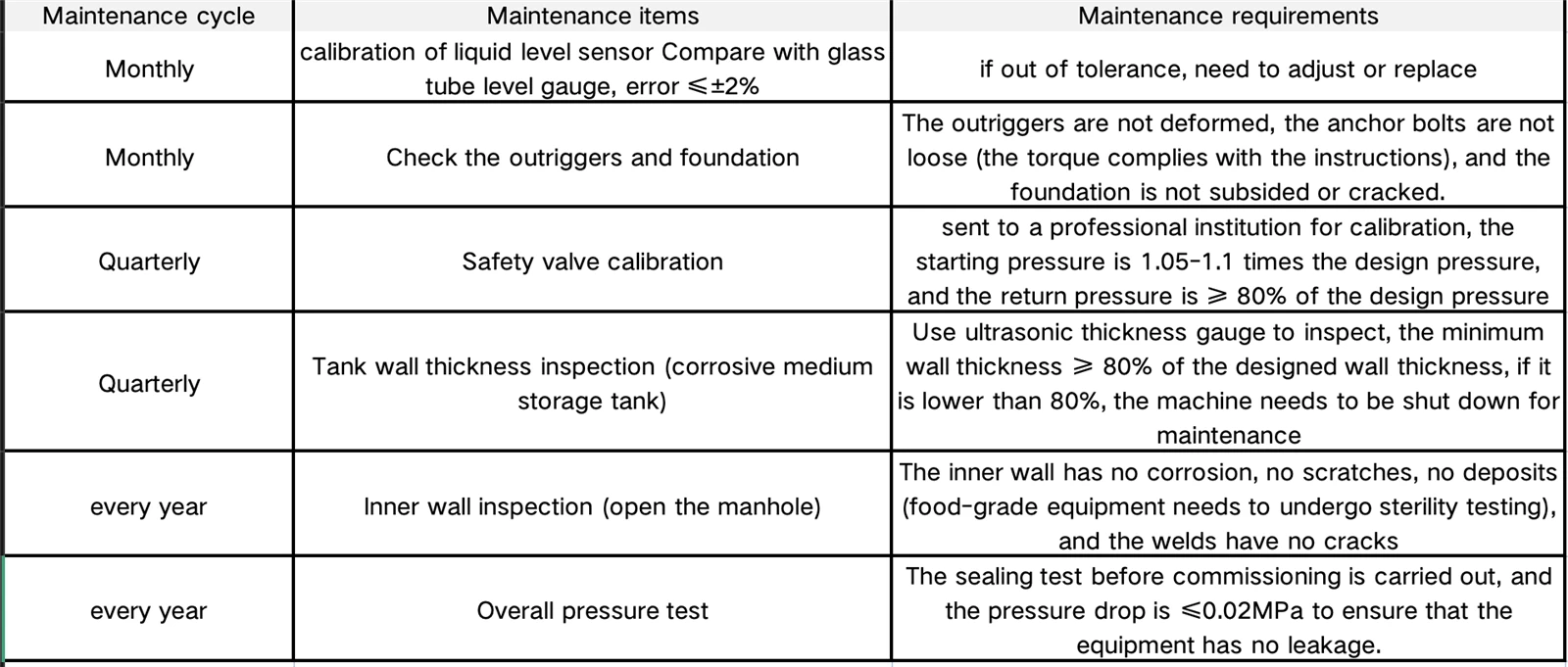
3. Scrapping Criteria (Exceeding the expiration date)
Vertical liquid storage tanks must be scrapped and must not be used further if the following conditions occur:
Structural damage: Cracks (regardless of size) in the tank wall, deformation of the support legs (tilt angle > 1°), corrosion and perforation of the tank bottom (or wall thickness < 50% of the design thickness);
Functional failure: Safety valve calibration failure (failure to trip or trip pressure error), level sensor calibration failure (error > 5%), emergency shut-off valve failure;
Material degradation: Softening and cracking of plastic liquid storage tanks, and extensive rust on the inner wall of stainless steel liquid storage tanks (which cannot be repaired through passivation).


