Hey there! As an Air Handling Unit (AHU) supplier, I've had my fair share of experiences dealing with different customer needs. Today, I wanna talk about the specific needs of an AHU in a laboratory.
First off, let's understand what a laboratory is. It's a place where all sorts of scientific experiments and research are carried out. These activities often involve chemicals, biological agents, and sensitive equipment. So, the AHU in a lab has to meet some pretty strict requirements.
Air Quality Control
One of the most crucial needs in a laboratory is maintaining high - quality air. Labs can produce all kinds of pollutants, like chemical fumes, dust, and microbial contaminants. If these aren't properly removed, they can not only affect the accuracy of experiments but also pose a serious health risk to lab personnel.
For example, in a chemistry lab, volatile organic compounds (VOCs) are released during chemical reactions. These VOCs can cause headaches, dizziness, and even long - term health problems. An AHU with high - efficiency particulate air (HEPA) filters and activated carbon filters is essential. HEPA filters can trap particles as small as 0.3 microns, including dust, pollen, and some bacteria. Activated carbon filters, on the other hand, are great at adsorbing gaseous pollutants like VOCs.
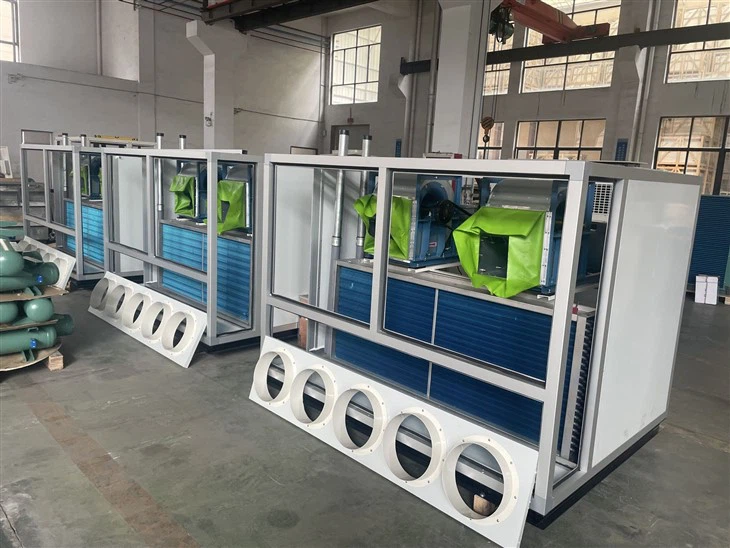
We offer a Modular Air Handling Unit (AHU) | Efficient Ventilation & Climate Control For Industrial And Commercial Buildings that comes with state - of the - art filtration systems. These units can be customized to fit the specific air quality requirements of different labs. Whether it's a small research lab or a large industrial testing facility, our AHUs can ensure that the air inside the lab is clean and safe.
Temperature and Humidity Regulation
Another key aspect is temperature and humidity control. Many experiments in a laboratory are highly sensitive to changes in temperature and humidity. For instance, in a biological lab, cell cultures need to be kept at a specific temperature and humidity level to grow properly. If the temperature is too high or too low, or the humidity is off - balance, the cell cultures can die, ruining the experiment.
An AHU for a laboratory should be able to maintain a stable temperature and humidity environment. It should have a precise control system that can adjust the cooling and heating capacity according to the real - time conditions in the lab. Our Air Handling System is equipped with advanced sensors and control algorithms. These sensors constantly monitor the temperature and humidity levels, and the control system makes instant adjustments to keep the conditions within the desired range.
Ventilation Rate
Proper ventilation is vital in a laboratory. A high ventilation rate helps to remove pollutants quickly and prevent the buildup of hazardous substances. The ventilation rate in a lab is usually measured in air changes per hour (ACH). Different types of labs have different ACH requirements. For example, a microbiology lab may require 12 - 15 ACH, while a chemical lab may need 15 - 20 ACH or even higher.
Our Air Handling Unit System can be designed to achieve the required ventilation rate. We use high - performance fans and ductwork systems to ensure efficient air circulation. This not only helps to maintain a safe environment but also improves the overall comfort of the lab personnel.
Noise Level
In a laboratory, noise can be a real problem. Excessive noise can interfere with experiments, especially those that involve sensitive equipment or require a quiet environment. For example, in a spectroscopy lab, noise can cause errors in the measurement results.
Our AHUs are designed with noise reduction in mind. We use sound - absorbing materials in the construction of the units and optimize the fan design to minimize noise. This way, the AHU can operate quietly without disturbing the work in the lab.

Energy Efficiency
Running an AHU can consume a significant amount of energy, especially in a laboratory where it needs to operate continuously. Energy efficiency is, therefore, an important consideration. An energy - efficient AHU can help to reduce operating costs and is also better for the environment.
We offer AHUs that are designed with energy - saving features. For example, our units use variable - speed drives (VSDs) for the fans and pumps. VSDs can adjust the speed of the equipment according to the actual demand, which means less energy is wasted. Additionally, our AHUs are well - insulated to prevent heat loss or gain, further improving energy efficiency.
Flexibility and Scalability
Laboratories often change over time. New experiments may be introduced, or the layout of the lab may be modified. An AHU should be flexible and scalable to adapt to these changes.
Our modular AHUs are a great solution in this regard. They can be easily expanded or reconfigured to meet the changing needs of the lab. Whether you need to add more filtration capacity, increase the ventilation rate, or change the temperature control settings, our modular units can be adjusted accordingly.
If you're in the market for an AHU for your laboratory, I'd love to have a chat with you. We can discuss your specific requirements and come up with the best solution for your lab. Whether it's air quality control, temperature and humidity regulation, or any other aspect, we've got the expertise and the products to meet your needs.
References
- "Laboratory Ventilation Design Guide" by the American Society of Heating, Refrigerating and Air - Conditioning Engineers (ASHRAE).
- "Air Quality in Laboratories: Principles and Practices" by various experts in the field of laboratory safety and ventilation.